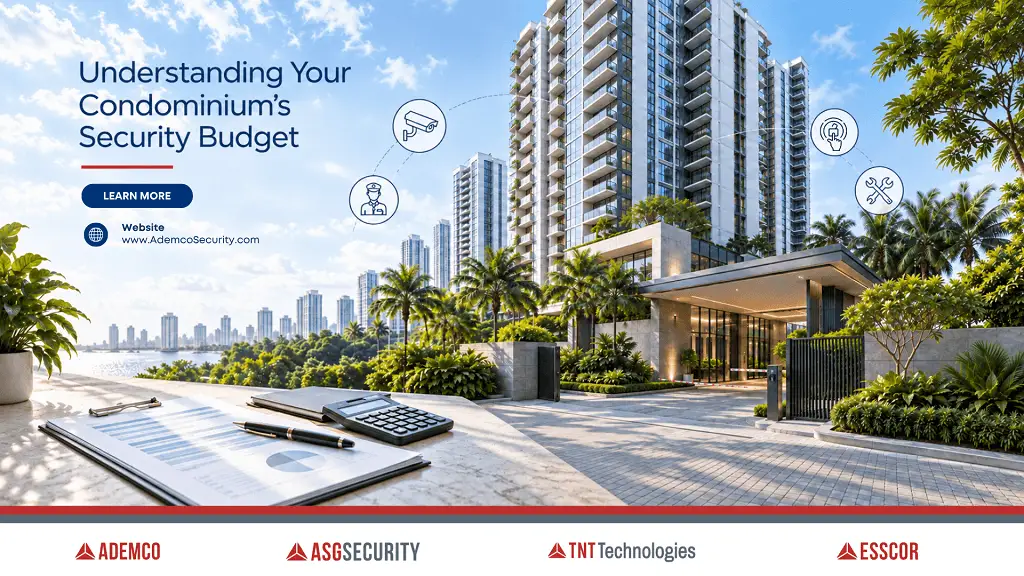
An MCST committee is reviewing next year’s budget, and the security line item has gone up again, with the explanation rarely going beyond “manpower costs.” Most residents, and more than a few committee members, never get much further than that single number. This guide breaks down what’s actually in a condo’s security budget, what tends to push it upward over time, and which questions are most helpful when a figure needs explaining at a general meeting.
What’s Actually Inside the Security Line Item?
“Security” on an MCST budget statement is rarely one cost. It’s usually a bundle of several items: manpower for on-site guards, a monitoring or alarm-response contract, equipment maintenance for cameras and access-control hardware, and sometimes a separate line for visitor management or software licensing. Most security systems in Singapore condominiums combine access control, CCTV, and visitor management, and each of these components can have its own contract, renewal date, and cost driver.
Under the Building Maintenance and Strata Management Act, every private condominium is run by a Management Corporation Strata Title, or MCST, which is legally responsible for maintaining these systems in common areas. Security typically sits under the management fund that residents pay into monthly, and it’s usually one of the largest recurring items in that fund.
In short, a single “security” figure on a budget statement is usually several separate contracts bundled together, and knowing which is which is the first step to actually reading it.
What’s Driving the Rising Manpower Costs?
This is the part committees feel directly, but don’t always have the full picture on. Guard, cleaning, and landscaping wages are governed by Singapore’s Progressive Wage Model (PWM), which sets scheduled minimum wage increases across the industry. Since these increases apply to every licensed agency, not just the one a condominium currently uses, they tend to put upward pressure on the manpower portion of a security budget over time.
That said, the guarding rate on a quote isn’t determined by PWM alone. It also reflects factors such as the officer grade requested, supervisory ratios, shift and relief coverage, the service standards specified in the contract, and each agency’s operational overheads and margins, so two quotes for the same headcount can differ for reasons that have nothing to do with wages. Assuming the deployment requirements are held constant across quotes, the underlying PWM wage pressure on the manpower component doesn’t disappear — so a guard rate that looks unusually low is worth understanding rather than simply celebrating, since it may reflect a different grade, scope, or service level rather than a straightforward saving.
The manpower portion of a security budget is shaped by wage regulation as well as by the deployment and service level agreed with a provider, so switching agencies won’t necessarily bring that portion down if the same deployment requirements stay in place.
Which Part of the Budget Can Actually Move?

Not every line in a security budget behaves the same way. The PWM wage floor itself isn’t negotiable — every licensed agency has to meet it. But that’s not the only lever available: deployment decisions such as headcount, shift patterns, and relief coverage are choices a committee can influence, and adjusting them is one of the more direct ways to move the manpower portion of the budget. Equipment maintenance, monitoring contracts, and software or platform fees sit on a different footing again; they don’t follow a wage schedule, and they tend to be more open to comparison between providers.
The table below provides a simplified view of the split. It isn’t a quote, since actual figures depend on the building and existing contracts, but it illustrates where the budget is flexible and where it isn’t.
| Budget component | What drives the cost | How negotiable is it |
| Guard manpower hours | PWM wage floor, officer grade, supervisory ratio, headcount, shift and relief coverage | Wage floor is fixed by law; headcount and shift/relief coverage can be adjusted by the committee |
| Monitoring, equipment maintenance, and platform or software fees | Contract terms, scope, and technology used | More negotiable — varies by provider and scope |
The wage-floor portion of a security budget is fixed by regulation, but deployment choices such as headcount and shift coverage, along with the equipment and monitoring portion, are where a committee generally has more room to compare, question, and adjust.
Reading a Sudden Jump in the Line Item
When the security figure jumps well beyond the usual PWM schedule, it’s worth asking what actually changed. Sometimes it’s a scheduled wage increase across the industry; sometimes it’s a scope change, such as added guard hours, a new monitoring contract, or hardware nearing the end of its life and due for replacement. A provider or managing agent should be able to point to which of these it is, with the relevant contract or PWM wage table to back it up.
It’s also worth asking whether any of the manpower-heavy tasks, such as manually logging visitors or checking access credentials at a gate, could be shifted to access-control or visitor-management technology instead. That doesn’t remove the need for guards, but it can reduce the number of guard-hours tied up in routine admin work, which is one of the more direct levers a committee has over the manpower side of the budget, alongside adjusting headcount and shift coverage.
A sudden increase is either a scheduled wage adjustment, a scope change, or both, and asking for the specific driver, rather than accepting “manpower costs” as the full explanation, is a reasonable thing for a committee to expect.
Questions Worth Asking Before the Next AGM
A few direct questions tend to get more useful answers than a general request to “explain the increase”:
Which portion of the increase is tied to the PWM wage schedule, and which is a scope or contract change? Is the current guarding rate at or above the wage floor for the specified officer grade? What’s included in the monitoring or maintenance contract, and when is it due for renewal? Is any part of the manpower-intensive work, such as visitor logging or access checks, a candidate for automation without reducing coverage? What’s the total cost over the full contract term, not just the monthly or annual figure quoted?
A committee that can answer these five questions is generally in a much stronger position at a general meeting than one working from the total figure alone.
Frequently Asked Questions
Why did our security costs go up even though nothing changed on-site?
Often, the Progressive Wage Model is a major factor. It applies scheduled wage increases to every licensed security agency, so costs can rise even when guard numbers, hours, and providers stay exactly the same. Scope changes on your specific contract can also play a part, so it’s worth asking your provider to confirm which applies.
Is it normal for security to be the largest line item in MCST fees?
Yes, it commonly is. Guarding, monitoring, and equipment maintenance together often make up one of the highest recurring costs in a management fund, alongside cleaning and utilities.
Can our committee negotiate the guarding rate below the PWM wage floor?
No. The PWM wage floor is a legal minimum that every licensed agency must meet, so a quote below that floor for the stated officer grade should be questioned rather than accepted. That said, the overall guarding rate can still legitimately vary between quotes for reasons unrelated to the wage floor, such as officer grade, supervisory coverage, or service scope.
What should we ask if a provider proposes adding technology to cut costs?
Ask which specific guard-hours it’s meant to replace, what it costs on top of the existing guarding contract, and what the total cost looks like over the full contract term, not just the first year.
Do we need a general meeting to approve a change to our security budget?
Generally, yes. Changes affecting common property and recurring costs usually require a vote at a general meeting, since they draw on the management fund that every resident contributes to.
PWM-linked costs are expected to keep rising, but a clearer read of the budget puts a committee in a stronger position to question it. If you’d like a line-by-line look at your own building’s numbers, or want to understand what a blended guarding-and-technology model, such as Ademco’s VerifSuite Estate, could mean for your specific figures, speak to our estate security team.