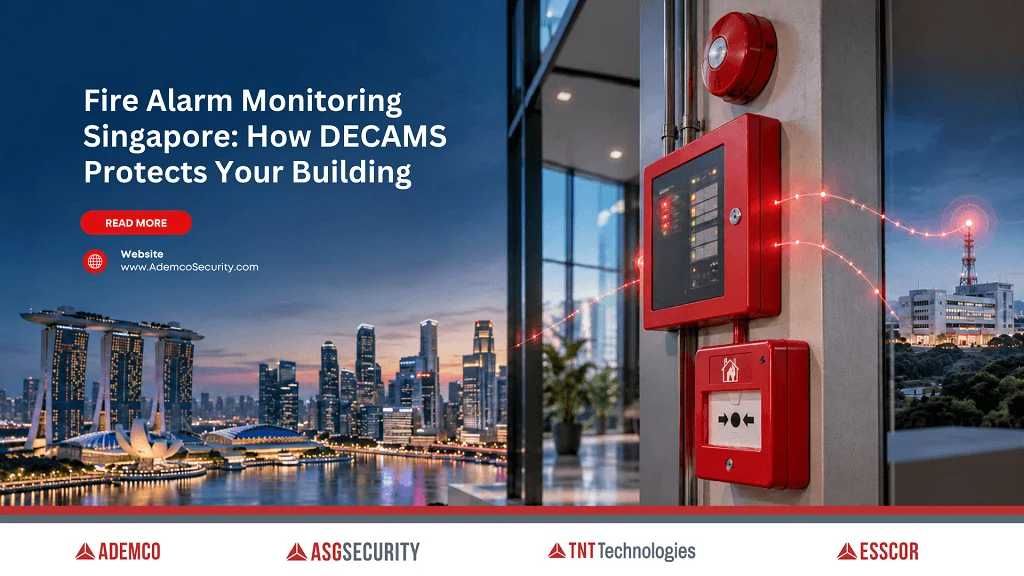
A building manager gets a call about a triggered fire alarm and has no idea if it’s real or a false trip until someone physically checks the panel. Here’s the direct answer. Fire alarm monitoring in Singapore, commonly called DECAMS, connects a building’s fire alarm system to the Singapore Civil Defence Force Operations Centre through a licensed monitoring provider, so alarm signals reach SCDF automatically while getting verified in parallel, rather than relying on someone physically catching it.
DECAMS isn’t optional for every building. Under the Fire Code, specific building types and sizes must be connected to SCDF through an approved alarm monitoring company, and the licensing for this sits under Part 3B of the Fire Safety Act. If your building falls into one of these categories, you’re not choosing whether to have this. You’re choosing who monitors it.
This article covers how DECAMS actually works, who’s required to have it, and what building managers should check before relying on it.
What Is DECAMS and How Does It Work?
DECAMS stands for Decentralised Alarm Monitoring Station. When a fire alarm triggers inside a building, the signal is sent simultaneously to the DECAMS operator and the SCDF Operations Centre, and the operator carries out verification in parallel by contacting the building’s keyholding personnel. This has been part of Singapore’s fire safety framework since the 1980s, when it was introduced specifically to cut down on false alarms straining emergency response resources.
Only licensed operators can run this service. Under Part 3B of the Fire Safety Act, providing alarm monitoring services requires a licence, and applicants must go through a pre-application consultation with SCDF before applying. This isn’t a light regulatory touch. It’s a controlled system precisely because false or unverified signals waste emergency resources that are needed elsewhere.
In short: DECAMS connects your building’s fire alarm to SCDF through a licensed operator, and that licensing exists specifically to keep false alarms from draining emergency response capacity.
Does Every Building in Singapore Need DECAMS?
No, not every building. The Fire Code sets specific thresholds. A warehouse over four storeys needs an automatic alarm system regardless of floor area, while a smaller warehouse of two to four storeys only needs one if it exceeds 1,000 square metres per storey, and that manual system doesn’t require monitoring company connection at all. Factories follow a similar tiered structure based on storey count and floor area.
This matters because the requirement isn’t a blanket rule. It depends on your building’s specific size, height, and use, and Clause 6.3.8 of the current Fire Code sets out exactly which categories must connect to SCDF via DECAMS.
In short: whether your building needs DECAMS depends on its height, floor area, and use, not a single rule that applies to every property, so it’s worth checking your building’s specific classification rather than assuming.
What Happens If the Fire Alarm Needs to Be Switched Off for Maintenance?
This is a detail a lot of building managers get wrong, and it’s worth being precise here since the rules changed recently. SCDF issued updated isolation duration requirements that took effect on 16 October 2025. On weekdays between 8am and 6pm, isolation is capped at four hours per block, and all isolations must end by 6pm regardless of when they started. Outside those hours, on weekday evenings after 6pm and on weekends and public holidays, the cap drops to a maximum of two hours per block.
Any extension needs to be requested in advance from your DECAMS operator, not decided on the spot. If no extension is requested before the isolation period ends, the system automatically goes back to live status, and once it’s live, the operator is required to treat every signal as a genuine fire incident.
In short: isolating your fire alarm for maintenance isn’t a simple switch. It has a strict four-hour cap on weekdays, and missing the deadline means every alarm afterwards gets treated as real, whether it is or not.
| Isolation scenario | What applies |
| Weekday maintenance, 8am to 6pm | Maximum 4 hours per block, must end by 6pm |
| Weekday evenings after 6pm, weekends & public holidays | Maximum 2 hours per block |
| Extension needed | Must be requested in advance from the DECAMS operator |
| No extension requested | Isolation ends automatically, system reverts to live |
| System live | Operator must treat all signals as genuine incidents |
How Do You Choose a DECAMS Provider?
The most basic check is licensing. A provider has to hold a valid licence under Part 3B of the Fire Safety Act to legally offer this service, and they should be able to confirm that without hesitation.
Beyond licensing, false alarm handling is worth asking about directly. A provider’s track record on this matters: it’s reasonable to ask how long they’ve run this kind of service and what their verification process actually looks like when a signal comes in.
Zero false alarms are not always achievable, as some activations may be caused by faulty detectors or genuine near-miss situations that still require attention. What matters is how quickly and accurately those signals get verified once they’re received, since that verification runs in parallel rather than as a gate before SCDF is alerted.
Frequently Asked Questions
Is DECAMS the same as a regular fire alarm system?
No. A regular fire alarm sounds locally within the building. DECAMS is the connection that sends that alarm signal to a monitoring operator and to SCDF at the same time, so it works alongside your existing fire alarm rather than replacing it.
Can a building switch its fire alarm off during renovation works?
Only within strict limits. Weekday isolation is capped at four hours per block and must end by 6pm, and any extension has to be requested from the DECAMS operator in advance rather than assumed.
What happens if my building doesn’t meet the DECAMS threshold but I want monitoring anyway?
Some building owners choose monitoring voluntarily even when the Fire Code doesn’t strictly require it, particularly for buildings with valuable equipment or high occupancy. This is worth discussing directly with a licensed provider rather than assuming it’s all or nothing.
How is DECAMS different from having security guards check the alarm panel manually?
A guard checking a panel manually depends on someone noticing and interpreting the signal correctly in the moment. DECAMS automates transmission process, which matters most outside staffed hours when a manual check might not happen quickly.
Who do I contact if I’m not sure whether my building needs DECAMS?
A licensed DECAMS operator can confirm this for you. Your building’s specific classification under the Fire Code determines this, based on height, floor area, and use. A licensed DECAMS operator can help confirm which category your building falls under.
If you’re not sure whether your building meets the DECAMS threshold, or your current monitoring setup hasn’t been reviewed against the updated isolation rules, it’s worth checking before an inspection flags it for you. Get in touch with our team to review your building’s fire alarm monitoring setup.